
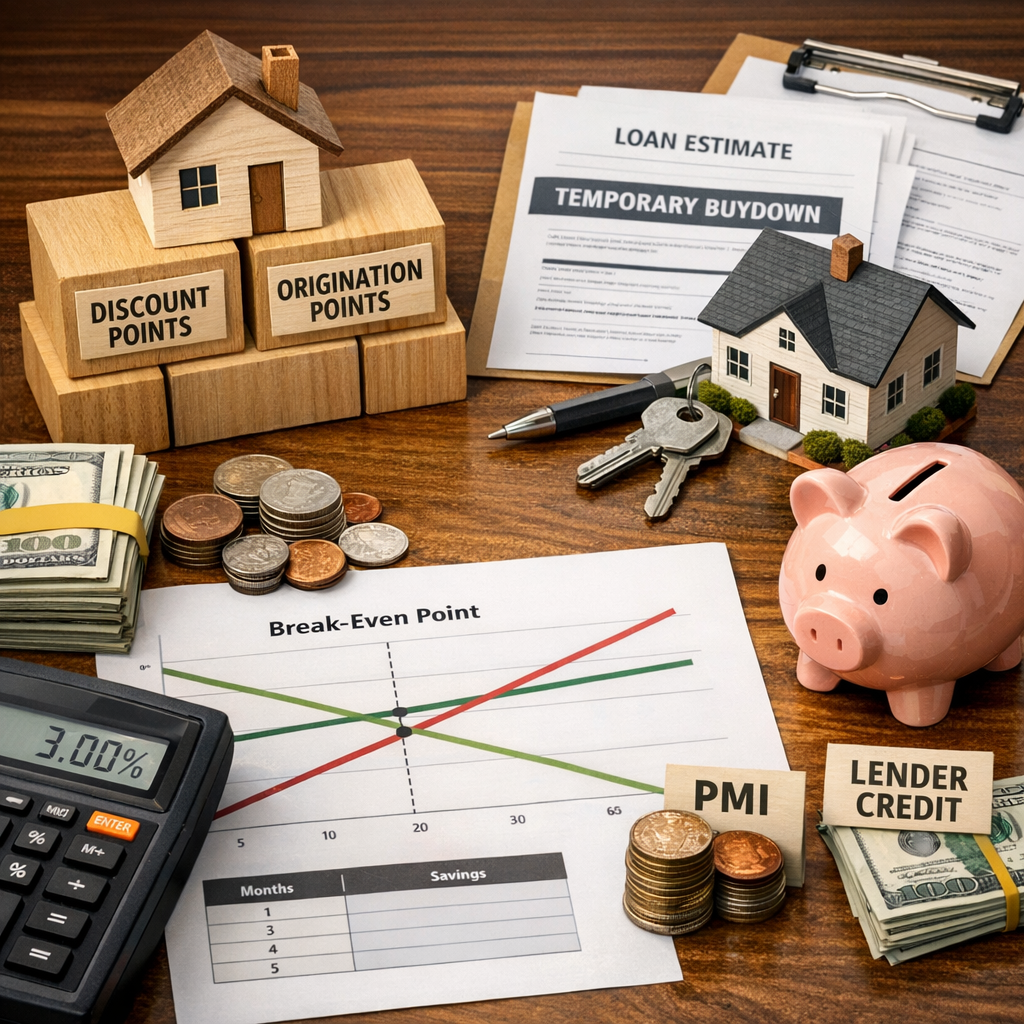
Mortgage points give you a simple lever to fine-tune your home financing strategy. By paying more upfront, you can reduce your interest rate and monthly payment. The decision affects affordability, tax planning, and how fast you build equity. If you understand how points work, when they make sense, and how to compare offers, you can turn a confusing line item on a Loan Estimate into a useful tool.
Mortgage Points Explained in Plain Terms
Mortgage points are fees paid at closing that are tied to your interest rate. One point equals 1 percent of your loan amount. On a $400,000 mortgage, one point costs $4,000. Points can either reduce your rate or compensate a lender for originating your loan, so it is crucial to know which type you are being quoted.
Discount Points: Prepaying Interest for a Lower Rate
Discount points are prepaid interest. You pay an upfront fee to reduce your interest rate for the life of the loan. A common rule of thumb is that one point lowers the rate by about 0.25 percentage points, but actual pricing changes day by day and by lender. The more points you buy, the lower your rate goes, up to the limits set by loan programs and your lender’s pricing.
Origination Points: A Lender Fee, Not a Rate Buydown
Origination points are a fee the lender charges to process and approve your loan. They increase your closing costs but usually do not lower your rate. Some lenders will show a mix of discount points and origination points on your Loan Estimate. Ask your loan officer to separate them so you can see the true cost of lowering your rate versus the cost of doing the loan.
Temporary Buydowns: 2-1 and 3-2-1 Structures
A temporary buydown reduces your rate for the first one to three years, then your rate returns to the note rate. A 2-1 buydown lowers the rate by 2 percentage points in year one and 1 percentage point in year two. These are often funded by a seller or builder credit. They are not the same as buying permanent discount points and need different math since the payment savings are front-loaded.
How Points Change Payment, APR, and Total Cost
The value of points comes from the trade-off between cash today and lower interest costs later. Use consistent comparisons across multiple lenders to judge the payoff.
Typical Pricing and Why It Varies
The rate reduction per point depends on market conditions, your credit profile, loan type, and lock period. On a given day, one point might lower a 30-year fixed rate by 0.125 to 0.375 percentage points. Adjustable-rate mortgages and jumbo loans may price differently. This is why comparing multiple quotes on the same day matters.
A Clear Example With Realistic Numbers
Assume a $400,000, 30-year fixed conventional loan.
- No points: 6.875 percent rate, principal and interest about $2,635 per month.
- Buy 1 point for $4,000: 6.625 percent rate, principal and interest about $2,559 per month.
Monthly savings: about $76. Break-even period: $4,000 divided by $76, which is roughly 53 months. If you expect to keep the loan longer than 4 years and 5 months, the point likely pays off. If you plan to sell or refinance sooner, paying points probably does not make sense.
Break-Even Math You Can Trust
Use a simple formula for permanent points:
- Break-even months = Total cost of points divided by Monthly payment savings
Refine the math with taxes if discount points are deductible for you. Also consider the time value of money. A conservative approach is to ignore tax benefits and assume that a dollar today is worth a bit more than a dollar later. That keeps your decision from relying on assumptions you cannot control.
When Buying Discount Points Makes Strategic Sense
Buying points fits best when a lower rate will serve you for a long time and when the upfront cash does not squeeze your other priorities.
You Expect to Keep the Loan Beyond Break-Even
If you plan to stay in the home and keep the mortgage past the break-even period, points can create meaningful long-term interest savings. The longer you hold the loan, the more attractive the permanent rate reduction becomes.
You Need a Lower Payment to Qualify or to Add Flexibility
A lower payment can improve your debt-to-income ratio and help with underwriting. Even if you qualify without points, a smaller monthly payment gives you breathing room for maintenance, insurance increases, or small rate changes on other debts.
You Have Ample Cash After Closing
Points are most effective when you already have an emergency fund, moving funds, and a budget for early home repairs. If points leave you short on reserves, they become a risk instead of a benefit.
You May Benefit From a Tax Deduction
Discount points on a primary residence can sometimes be deductible in the year paid, subject to IRS rules. If you itemize deductions and meet the requirements, the after-tax cost of points falls. Tax treatment varies, so confirm with a qualified tax professional.
When to Skip Points or Choose an Alternative
Sometimes there is a better use for your cash or a smarter structure that fits your plans.
You Expect to Refinance or Sell Soon
If you plan a refinance within a couple of years, paying points is rarely efficient. A rising credit score, a drop in market rates, or removing mortgage insurance may give you a refinance target. In that case, keep cash in hand and avoid prepaying interest you will not recover.
Your Cash Can Eliminate PMI or Raise the Down Payment
For low-down-payment loans, using cash to lift the down payment and remove private mortgage insurance may save more per month than buying points. For example, moving from 9 percent down to 20 percent down might reduce both PMI and the rate tier, which can beat the savings from points.
You Need Stronger Reserves or Have Higher-Interest Debts
High-interest credit card balances usually cost more than your mortgage rate, even after points. Paying those down first or keeping a healthier emergency fund can be a better financial move than buying a slightly lower mortgage rate.
No-Cost or Lender-Credit Options Look Better
Lenders can offer credits by giving you a slightly higher rate. This lowers your upfront closing costs. If cash is tight or your break-even is far out, taking a lender credit can be a practical alternative to buying points.
Negotiation and Implementation Tips That Save Money
How you shop and structure points can change the outcome by thousands of dollars.
Compare the Same Day, Same Lock Period, and Same Structure
Ask for quotes with the same down payment, loan type, and lock period. Request three versions from each lender: zero points, one point, and a lender-credit option that covers most costs. This helps you see the trade-offs clearly.
Read the Loan Estimate and the Rate Lock Agreement
On the Loan Estimate, Section A shows discount points and origination charges. Confirm which fees buy down the rate. After you lock, get a lock confirmation that lists the exact cost of points and the locked rate. If market pricing improves before closing, ask about a float-down option.
Leverage Seller Credits and Builder Incentives
Seller-paid points or builder incentives can fund a permanent buydown or a 2-1 buydown. If your choice is between a cosmetic upgrade and a permanent rate reduction, the rate reduction often has a higher financial return. Be sure credits comply with program caps and are shown on the Closing Disclosure.
Use APR as a Tie-Breaker, Not the Only Metric
APR helps you compare the total cost of credit, but it assumes you keep the loan full term. Use APR alongside break-even months and your realistic time horizon.
Program-Specific Considerations
Rules and pricing differ across loan types. Small details can affect how valuable points are for you.
Conventional Loans
Conventional pricing often shows clean trade-offs between points and rates. There may be caps on seller-paid points based on occupancy and down payment. Private mortgage insurance interacts with this calculus, so compare scenarios with and without PMI.
FHA and VA Loans
FHA allows discount points and temporary buydowns, and the upfront mortgage insurance premium is separate from points. VA loans can use seller credits for points and buydowns within limits. VA interest rate reduction refinance loans have separate rules, so avoid points if a quick IRRRL is likely.
USDA and Jumbo Loans
USDA loans have guarantee fees that are separate from points, and they limit contributions. Jumbo loans can price points differently, sometimes offering larger rate moves per point or tighter limits. Always check lender overlays.
Temporary Buydowns vs. Permanent Points
Choosing between a temporary buydown and permanent discount points depends on cash flow and time horizon.
Temporary Buydowns for Early-Year Relief
If a seller funds a 2-1 buydown, your first two years of payments are lower without your cash outlay. That can ease the move-in period while you furnish the home or finish renovations. Since the rate steps up later, plan for the full note payment by year three.
Permanent Points for Long-Term Savings
Permanent points reduce your interest costs for the entire loan term. When you control the funding and plan to stay put, permanent points usually generate more total interest savings than a temporary buydown of the same dollar amount.
Practical Checklist Before You Decide
- Calculate break-even months for each quote and compare with your expected holding period.
- Confirm which fees are discount points versus origination points on your Loan Estimate.
- Evaluate alternatives: higher down payment, PMI removal, lender credits, or debt payoff.
- Stress test your budget with and without points to see the impact on cash reserves.
- Ask about seller or builder credits and program caps on concessions.
- Request written lock terms and check if float-down options are available.
- Discuss potential tax treatment of discount points with a qualified tax professional.
Make Mortgage Points Work for Your Home Purchase
Mortgage points are not a trick to shave a few dollars off your payment. They are a strategy for trading upfront cash for long-term savings and stability. When you run the break-even math, compare the same structure across multiple lenders, and align the decision with your time horizon and cash priorities, points can be one of the most effective tools in your home purchase plan. Treat them as part of an integrated strategy alongside your down payment, reserves, and negotiation leverage, and you will choose with clarity and confidence.
Leave a Reply