
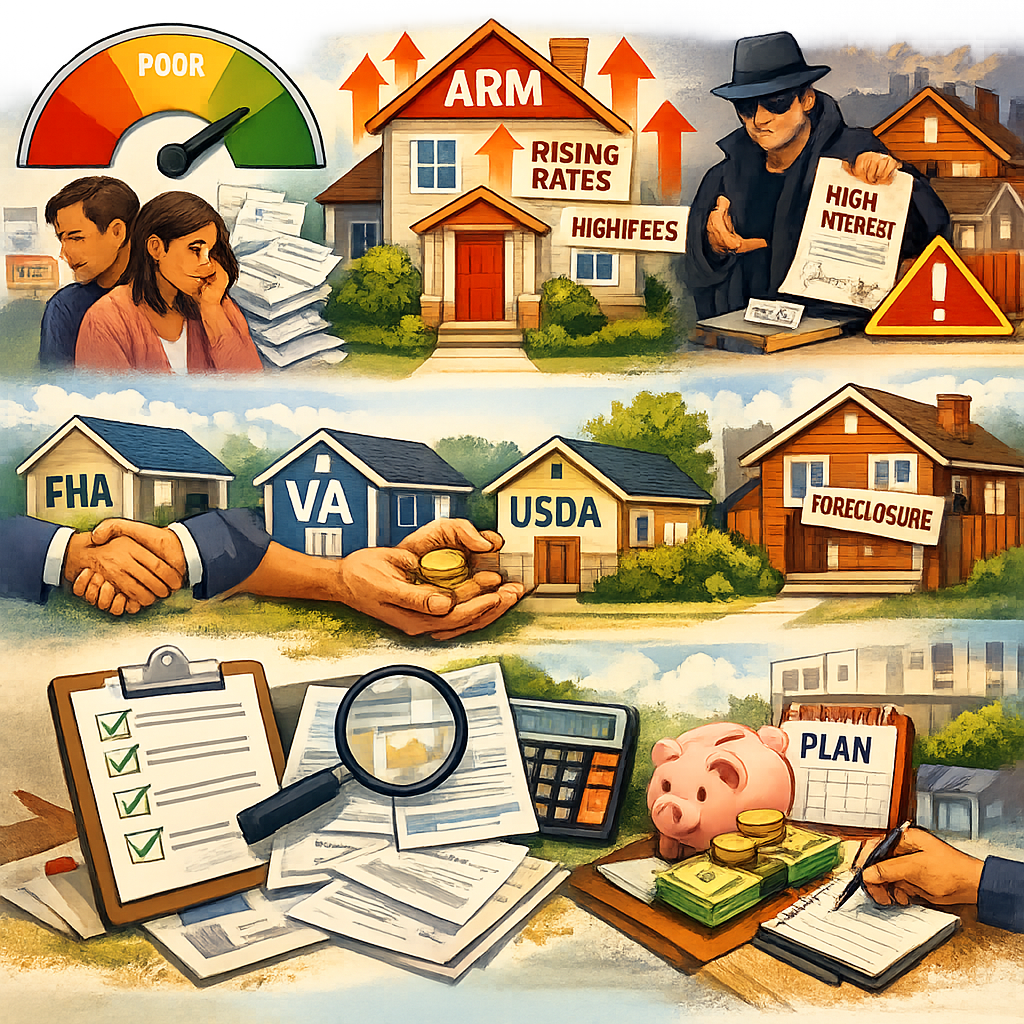
For many buyers with credit challenges, the promise of homeownership through a bad-credit home loan can feel like a lifeline. Subprime mortgages are built for applicants with lower credit scores or past financial setbacks, but they often carry higher costs and more complex terms. Understanding how these loans work and where the real risks show up can prevent years of stress, surprise costs, and the possibility of losing a home.
This guide explains the structure of subprime mortgages, the most common pitfalls, how to spot predatory terms, and the safer paths that can help you buy a home without putting your budget at risk.
What a Subprime Mortgage Really Means
A subprime mortgage is a home loan offered to borrowers who present higher credit risk. That risk can come from a credit score commonly below about 620, recent late payments, high debt-to-income ratios, thin credit history, or a past bankruptcy or foreclosure. These loans typically come with higher interest rates and fees to compensate lenders for the additional risk.
Not every nontraditional loan is subprime. Some loans fall under the non-QM (non-qualified mortgage) category because they document income differently, not because the borrower has poor credit. Still, many non-QM loans share features that can raise payment risk, so careful review is essential.
Who Lenders Often Classify as Higher Risk
- Borrowers with credit scores below about 620
- Applicants with recent delinquencies, collections, or a charge-off
- Self-employed borrowers with inconsistent income or limited documentation
- Households carrying high monthly debt payments relative to income
- Buyers with a bankruptcy or foreclosure within the last 2 to 7 years
Because risk translates to cost, subprime mortgages often have higher rates, origination charges, and stricter terms. The details of those terms matter.
How Subprime Loan Terms Create Risk
Subprime mortgages can look attractive at first glance because they may approve buyers who have been turned down elsewhere. The danger lies in rate adjustments, upfront and back-end fees, and structures that make refinancing harder later on.
Adjustable-Rate Structures and Payment Shock
Many subprime offers rely on adjustable-rate mortgage (ARM) designs. An ARM starts with a fixed rate for a short period, then adjusts regularly based on an index and a margin. Rate caps limit how much the rate can move at each adjustment and over the life of the loan, but the new payment can still be much higher than the initial payment.
- Teaser or introductory rates: A temporarily discounted starting rate can mask the true cost of the loan.
- Short fixed periods: Offers like a 2/28 or 3/27 ARM (two or three years fixed, then 27 or 28 years adjustable) create early and sometimes steep payment changes.
- Index plus margin: When short-term rates rise, your mortgage rate and monthly payment can rise along with them.
Payment shock happens when the first adjustment lands and the payment jumps by several hundred dollars per month, sometimes more. If income has not kept pace, default risk increases quickly.
Fees, Points, and Prepayment Penalties
Subprime mortgages often include higher origination fees or discount points. Fees increase the total cost of credit and can eat into home equity if rolled into the loan balance. Some loans add prepayment penalties that make it expensive to refinance or sell within the first few years. That penalty can trap a borrower in a bad rate just when a refinance would help the most.
Documentation and Underwriting Choices
Loans that allow reduced documentation, stated income, or limited asset verification raise the risk that the monthly payment will not line up with real cash flow. High debt-to-income allowances can also set borrowers up for strain when any unexpected expense occurs. Safer underwriting usually means full documentation, clear proof of income, and a budget that leaves room for savings.
The Main Risks to Your Budget and Home Equity
Every mortgage should be judged on its lifetime cost, flexibility, and how it fits within a stable household budget. Subprime mortgages can threaten all three if the structure is not understood.
Affordability Now vs. Affordability Later
A subprime loan may look affordable at the starting rate, but the scheduled adjustments can raise the payment beyond what is reasonable. Even fixed-rate subprime loans can be costly because the interest rate is higher from day one.
Refinancing and Liquidity Risk
Many borrowers plan to refinance after credit improves. That plan can fail if home values drop, if rates rise, or if strict underwriting returns. A prepayment penalty or a decline in equity can block the exit.
Equity Erosion and Foreclosure Consequences
Higher interest and fees reduce the pace at which principal is paid down. If the market softens, selling or refinancing may not clear the balance. Late payments and foreclosure damage credit for years, and the financial stress can spill into other bills and savings goals.
Red Flags That Signal Predatory Lending
Most lenders operate within clear rules, but some practices raise concern. Proceed with caution if you encounter any of the following:
- Pressure to sign quickly before you can compare offers
- Promises that “everyone” is approved at the same teaser rate regardless of credit
- Large fees or points with little explanation, or fees added at the last minute
- Prepayment penalties that last longer than the ARM’s fixed period
- Balloon payments due within the first 5 to 7 years
- Income inflated by the loan officer or a push to “state” more income than you earn
- Loan flipping, where you are urged to refinance repeatedly with more fees each time
Regulations such as the Ability-to-Repay and Qualified Mortgage rules limit some of the worst features. Still, careful review and independent advice remain vital, especially for non-QM loans that do not meet QM standards.
Safer Options That Often Beat Subprime Offers
Before accepting a high-cost mortgage, compare programs designed to support buyers with limited savings or imperfect credit.
FHA Loans
FHA mortgages allow lower credit scores and small down payments, and they require full documentation. Mortgage insurance is mandatory, but rates and closing terms are often more forgiving than subprime pricing. A strong FHA alternative can save hundreds per month compared with a similar subprime loan.
VA and USDA Loans
Eligible veterans, service members, and some surviving spouses may qualify for VA loans with no down payment and competitive rates. USDA loans serve rural and some suburban areas with income limits and offer low rates with zero down. Both options commonly beat subprime pricing for qualified borrowers.
State and Local Assistance
Housing agencies offer down payment assistance, grants, or second-lien support that can pair with FHA, VA, or conventional loans. These programs can cover part of the upfront costs and help a buyer enter a safer primary mortgage.
Improve First, Then Buy
Waiting 6 to 12 months to reduce credit card balances, settle collections, or build a longer on-time payment streak can lift a score into a lower-risk tier. The payoff is often a lower rate, fewer fees, and a healthier housing budget.
If You Still Consider a Subprime Mortgage, Do This
Sometimes a subprime loan is the only path available right now. You can still lower the odds of payment shock and long-term regret.
- Favor a fixed-rate loan over a short-reset ARM, even if the starting rate is a bit higher.
- Aim for a payment that stays below about 28 to 31 percent of gross income and keeps total debt below roughly 36 to 43 percent, including the mortgage.
- Insist on full documentation. Verify income and assets to match a payment you can sustain.
- Shop at least three lenders or brokers and compare the APR, not just the interest rate.
- Reject loans with prepayment penalties that extend beyond the fixed period or longer than three years.
- Pay attention to points and fees. Ask for a zero-point quote and a quote with points, then calculate the break-even time.
- Set aside an emergency fund equal to at least three months of total expenses, including the new payment.
- Get a written explanation of the ARM index, margin, adjustment dates, caps, and worst-case payment.
- Review disclosures with a HUD-approved housing counselor or a trusted financial professional.
Simple Cost Comparisons to Keep You Grounded
Numbers clarify trade-offs. Here are two examples that show how pricing and structure affect your budget. These are illustrations, not current market quotes.
Higher Rate, Higher Lifetime Cost
Consider a $300,000 30-year fixed mortgage:
- At 7.0 percent, the monthly principal-and-interest payment is about $1,995.
- At 10.5 percent, the monthly principal-and-interest payment is about $2,743.
That is a difference of roughly $748 per month. Over five years, the higher-rate loan costs about $44,880 more in payments before taxes, insurance, and fees. You also pay down principal more slowly at the higher rate, which leaves less equity if you need to refinance or sell.
ARM Payment Shock in Practice
Imagine an ARM that starts at 6.5 percent for two years on the same $300,000 balance, then adjusts to 10.5 percent:
- First two years at 6.5 percent: payment about $1,896 per month.
- After reset at 10.5 percent: payment about $2,743 per month.
That jump of around $847 per month can overwhelm a household budget if income has not risen or if other debts have grown. A prepayment penalty would make escaping that jump even harder.
Make a Safer Plan for Home Financing
Homeownership should support long-term stability, not undermine it. Subprime mortgages can work for a narrow set of buyers who lock in predictable payments, avoid predatory terms, and have a clear path to improve credit. For many others, a better plan is to compare FHA, VA, USDA, and local assistance programs, trim debts, build savings, and strengthen credit until mainstream pricing becomes available.
Before signing, slow the process down and pressure-test the loan: model the highest possible ARM payment, total up fees, confirm there is no costly prepayment penalty, and check how fast principal will amortize. Then choose the option that keeps your budget steady through good times and bad. A careful approach today can protect your home equity, your credit profile, and your peace of mind for years to come.
Leave a Reply