
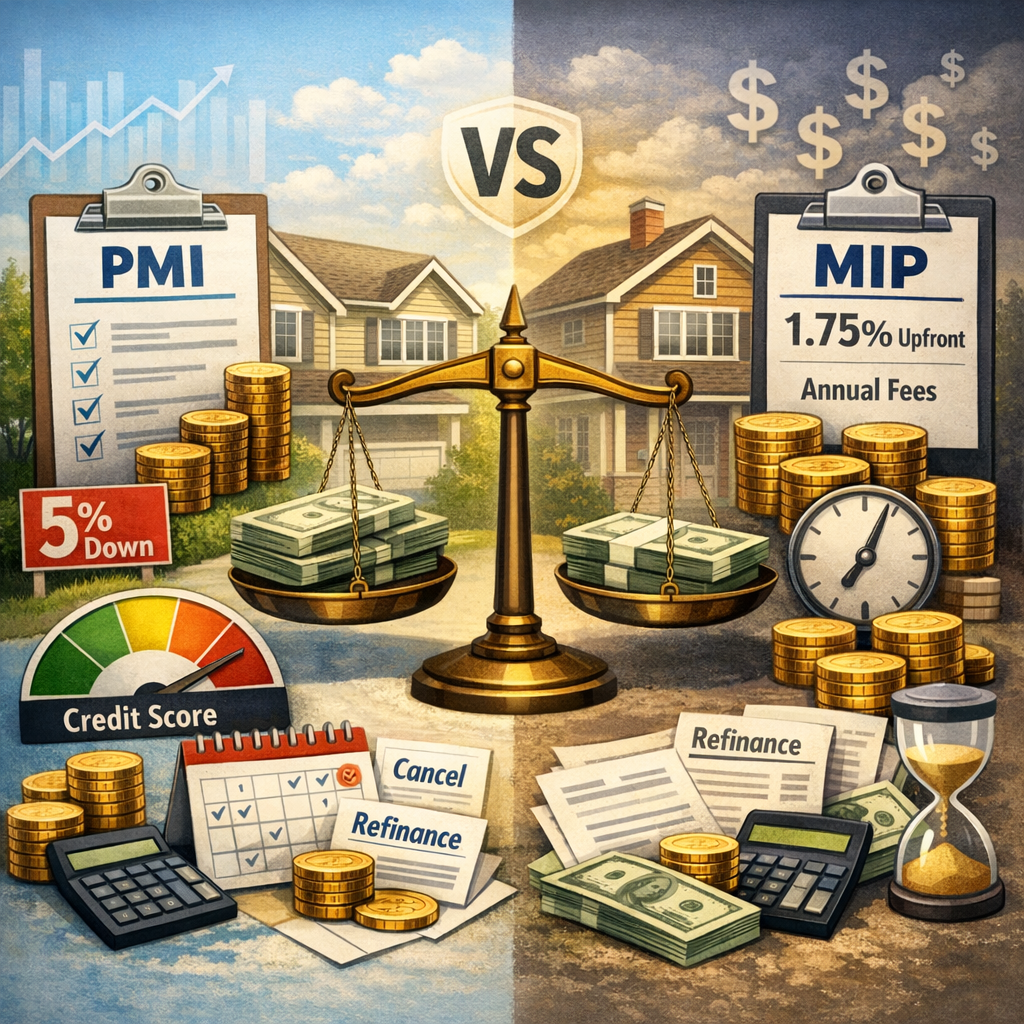
Buying a home often means deciding how to handle mortgage insurance. Private mortgage insurance and the FHA mortgage insurance premium can open the door to homeownership with a smaller down payment, but they add cost and come with different rules. Understanding how PMI and MIP work, what they cost, and how to remove them can help you choose the right loan and avoid paying more than you need.
What Mortgage Insurance Does and Why Lenders Require It
Mortgage insurance protects the lender if a borrower defaults. It does not protect your home or your household belongings, and it is not the same as homeowners insurance. Lenders use mortgage insurance to reduce risk when a borrower makes a small down payment or has a higher risk profile. In exchange, the lender is willing to approve a loan that might not have been possible otherwise, often at a competitive interest rate compared to other high-risk options.
Two common forms appear in consumer mortgages. PMI applies to many conventional loans. MIP applies to FHA loans. The coverage types, pricing, and cancellation rules differ in ways that can affect your monthly payment and your long-term costs.
PMI vs MIP: How They Differ and When Each Applies
Both PMI and MIP add a premium to your mortgage payment, but they apply to different loan types and follow different rules over time.
PMI on Conventional Loans
PMI, or private mortgage insurance, typically applies when you take out a conventional loan with less than 20 percent down. The premium depends on your credit score, down payment, and loan features.
- Typical cost: about 0.20 percent to 1.50 percent of the loan amount per year.
- Payment options: monthly borrower-paid PMI, single-premium PMI, split-premium PMI, or lender-paid PMI with a higher interest rate.
- Cancellation: strong consumer protections allow you to remove PMI once you have enough equity.
PMI can be temporary. That is one of its biggest advantages if you expect to build equity quickly through payments, home improvements, or market appreciation.
MIP on FHA Loans
MIP, or mortgage insurance premium, is required on FHA loans regardless of credit score or down payment size. It has two parts: an upfront premium and an annual premium.
- Upfront MIP: typically 1.75 percent of the base loan amount. Many borrowers roll this into the loan instead of paying cash at closing.
- Annual MIP: often around 0.55 percent of the loan amount for many 30-year FHA loans, with the exact percentage based on loan term and loan-to-value.
- Cancellation: for FHA loans with less than 10 percent down, annual MIP usually lasts for the life of the loan. With 10 percent or more down, MIP may drop off after 11 years.
FHA is often more flexible with credit and debt-to-income ratios. The tradeoff is that MIP can be harder to eliminate without refinancing into a conventional loan.
How Much Does Mortgage Insurance Cost? Clear Examples
Costs vary by lender, credit profile, loan size, and loan features. The following examples illustrate how PMI and MIP can show up in a budget. Numbers are estimates for comparison, not quotes.
Example: Conventional Loan With PMI
Purchase price: $400,000. Down payment: 5 percent ($20,000). Loan amount: $380,000. Assume a PMI rate of 0.58 percent per year for a strong-credit borrower.
- Annual PMI: $380,000 x 0.0058 = $2,204
- Monthly PMI: about $184
PMI can be removed once you reach about 20 percent equity. You can request removal at 80 percent loan-to-value based on the original value, or sooner with a new appraisal if your home value has increased and your payment history is clean.
Example: FHA Loan With MIP
Purchase price: $400,000. Down payment: 3.5 percent ($14,000). Base loan amount: $386,000. Upfront MIP at 1.75 percent: $6,755. If financed, the note would reflect the base loan plus the financed upfront premium. Assume an annual MIP of about 0.55 percent.
- Annual MIP: $386,000 x 0.0055 = $2,123
- Monthly MIP: about $177
The monthly MIP looks similar to PMI in this scenario, but the upfront MIP adds to your financed balance. If you put less than 10 percent down, annual MIP remains for the life of the loan unless you refinance into a conventional mortgage.
Comparing 5-Year Costs
Assume both loans stay in place for five years with no refinance:
- Conventional PMI: about $11,000 in PMI over five years at the example rate, unless cancelled earlier due to rising equity.
- FHA MIP: about $10,600 in annual MIP over five years plus the 1.75 percent upfront premium. Total cost would be higher if the upfront MIP was financed because of interest on the added balance.
If home values climb and you reach 20 percent equity quickly, the conventional borrower could request PMI cancellation and reduce total cost. The FHA borrower would likely need to refinance into a conventional loan to remove MIP if the initial down payment was below 10 percent.
How to Pay PMI: Options and Tradeoffs
Borrowers often focus on monthly PMI, but there are multiple ways to structure it. The right choice depends on how long you plan to keep the loan and how quickly you expect to reach 20 percent equity.
Monthly Borrower-Paid PMI
The most common structure adds a line item to your monthly payment. You can cancel it once you qualify, which makes it flexible and often cost-effective if you plan to stay in the home long enough to reach 20 percent equity.
Single-Premium and Split-Premium PMI
Single-premium PMI is paid upfront at closing. It avoids a monthly charge, but it is not refundable if you sell or refinance soon. Split-premium PMI combines a smaller upfront payment with a reduced monthly amount and can be useful when you want to lower your payment but avoid a large lump sum.
Lender-Paid PMI (LPMI)
With LPMI, the lender covers the insurance and charges a higher interest rate instead. This usually lowers your initial monthly out-of-pocket compared to borrower-paid PMI, but you cannot cancel LPMI because it is baked into the interest rate. To remove it, you would need to refinance.
Removing or Avoiding Mortgage Insurance
Knowing the rules for cancellation can save thousands of dollars and help you decide between loan programs.
Canceling PMI on Conventional Loans
- Request at 80 percent LTV: You can ask the servicer to remove PMI when your principal balance reaches 80 percent of the original value. You may need a property value confirmation and a strong payment history.
- Automatic at 78 percent LTV: By law, PMI drops off automatically when the balance reaches 78 percent of the original value based on the initial amortization schedule.
- Early removal with appreciation: If your home value has risen, a new appraisal can support an earlier cancellation request. Lenders set seasoning and documentation rules, so ask about their process and fees.
Managing or Eliminating MIP on FHA Loans
- 11-year rule: If you put 10 percent or more down, annual MIP can fall off after 11 years.
- Life-of-loan rule: If you put less than 10 percent down, annual MIP typically lasts for the full loan term.
- Refinance path: Many borrowers refinance into a conventional loan once their credit, equity, and income qualify. This is the most common way to remove MIP.
- Upfront MIP refunds: If you refinance from one FHA loan to another FHA loan within a set period, you may receive a partial refund of the upfront MIP that reduces the new loan’s upfront premium.
Building Equity Faster
- Make extra principal payments to reach 80 percent LTV sooner.
- Complete value-adding improvements and document them for an appraisal.
- Monitor your home’s market value and request a review when you believe you qualify.
Choosing Between FHA With MIP and Conventional With PMI
The better option depends on credit profile, down payment, and how long you expect to keep the loan.
When FHA Can Make Sense
- You have a modest down payment and a lower credit score where PMI pricing would be high.
- You need more flexible debt-to-income allowances.
- You plan to refinance or sell in a few years and value the easier upfront approval.
When Conventional With PMI May Win
- You have good to excellent credit that earns a low PMI rate.
- You want the ability to cancel mortgage insurance without refinancing.
- You can reach 20 percent equity in a reasonable timeframe through payments and appreciation.
Quick Comparison Checklist
- Compare total 5-year costs, including any FHA upfront MIP financing and expected PMI cancellation date.
- Check interest rate differences for FHA vs conventional, plus any LPMI rate bump.
- Verify mortgage insurance cancellation rules for the exact product you are considering.
- Estimate how long you will keep the home or the loan. Shorter horizons can change the best choice.
FAQs and Common Misconceptions
Does mortgage insurance protect me if I lose my job or get sick?
No. PMI and MIP protect the lender. Consider income protection or emergency savings for personal risk management.
Is PMI tax deductible?
Mortgage insurance deductibility has changed over time. Eligibility depends on current tax law and your income. Ask a tax professional before you count on any deduction.
Do VA or USDA loans require PMI or MIP?
VA and USDA loans do not use PMI or FHA MIP. VA loans charge a funding fee, and USDA loans use a guarantee fee and an annual fee. These serve a similar purpose and have their own rules.
Can I avoid mortgage insurance with a piggyback loan?
Some borrowers use an 80-10-10 or 80-15-5 structure, pairing a first mortgage with a small second mortgage to reach 20 percent combined equity. This avoids PMI but adds a second loan with its own rate and fees, so compare all-in costs and future flexibility.
Smart Next Steps for Navigating PMI and MIP
Start by deciding which loan type fits your credit, down payment, and timeline. Price both options on the same day and ask your lender for a standardized cost comparison that shows interest rate, upfront costs, monthly premium, and projected mortgage insurance cancellation date. Then model a few scenarios, including early PMI removal or a future refinance from FHA to conventional. Small differences in rate, premium, and cancellation can add up to thousands of dollars over the years.
The bottom line is simple. PMI can be a temporary bridge to ownership on a conventional loan, while MIP is part of the price of FHA’s flexible credit box. Choose the path that gets you into the right home with a payment you can sustain, and set calendar reminders to revisit your options as your equity grows.
Leave a Reply