
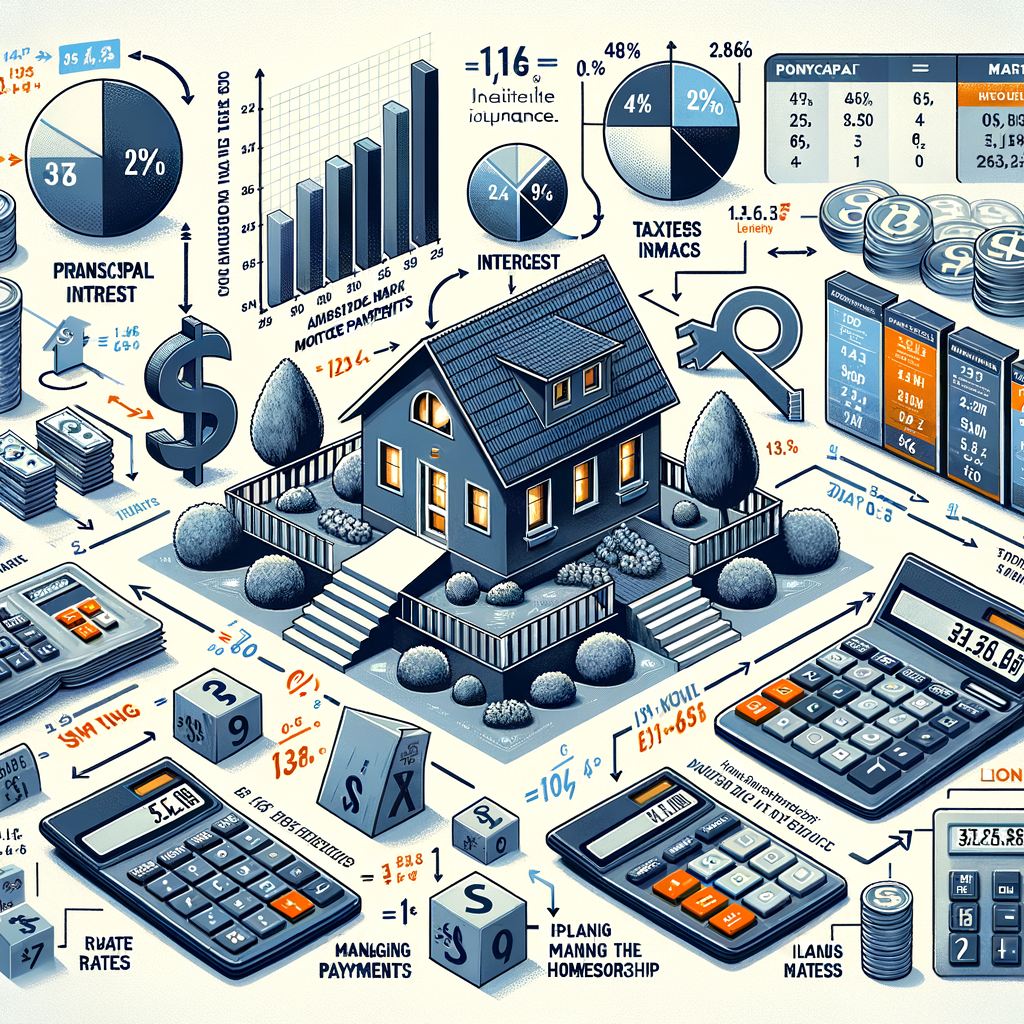
1. Understanding the Components of a Mortgage Payment
A typical mortgage payment consists of four main components, often referred to as PITI:
- Principal: The amount borrowed to purchase the home.
- Interest: The cost of borrowing the money, determined by your interest rate.
- Taxes: Property taxes assessed by your local government.
- Insurance: Homeowners insurance, and sometimes private mortgage insurance (PMI) if your down payment is less than 20%.
2. The Basic Mortgage Payment Formula
The formula for calculating the principal and interest portion of your mortgage payment is:
M = P[r(1 + r)n] / [(1 + r)n - 1]
Where:
- M = Monthly mortgage payment
- P = Principal loan amount
- r = Monthly interest rate (annual rate divided by 12)
- n = Total number of payments (loan term in years × 12)
3. Step-by-Step Example
Suppose you take out a $300,000 mortgage with a 4% annual interest rate for 30 years.
- Convert the annual interest rate to a monthly rate: 4% ÷ 12 = 0.333% or 0.00333.
- Calculate the total number of payments: 30 × 12 = 360.
- Plug the values into the formula:
M = 300,000[0.00333(1 + 0.00333)360] / [(1 + 0.00333)360 - 1]
After solving, the monthly principal and interest payment is approximately $1,432.25.
4. Adding Taxes and Insurance
To get your total monthly mortgage payment, add estimated property taxes and homeowners insurance. For example, if your taxes and insurance total $300 per month, your total payment would be $1,732.25.
5. Using Online Mortgage Calculators
While manual calculations are useful for understanding how mortgages work, online mortgage calculators can simplify the process. These tools allow you to input your loan amount, interest rate, and term to instantly see your estimated monthly payment.
6. Factors That Affect Your Mortgage Payment
- Interest Rate: A lower rate reduces your monthly payment and total interest paid.
- Loan Term: Shorter terms have higher monthly payments but lower total interest costs.
- Down Payment: A larger down payment reduces the loan amount and may eliminate PMI.
- Property Taxes and Insurance: These can vary significantly depending on location and coverage.
7. Tips for Managing Your Mortgage Payments
- Make extra payments toward the principal to reduce interest over time.
- Refinance if interest rates drop significantly.
- Set up automatic payments to avoid late fees.
- Review your escrow account annually to ensure accurate tax and insurance estimates.
Conclusion
Calculating your mortgage payments helps you understand the financial commitment of homeownership. By learning how principal, interest, taxes, and insurance contribute to your monthly payment, you can plan your budget more effectively and make confident decisions about your mortgage options.
Leave a Reply